Saturday, April 05, 2008

Have you ever heard anything more ridiculous than this? (I'm sure you have, but this got to be up there with the best of them...)

Sneezetics

A British gym has become the first to introduce a high impact calorie busting fitness craze which has swept through parts of America - sneezing classes. And the 30 minute workouts have already proved a huge hit with gym members keen to improve their fitness by simply sneezing.

Instructors from Fitness First have been flown to America to learn the finer points of the technique known as "Sneezetics." Each of them spent a week working with Dr April Jones the woman behind the fitness programme.

The self-styled fitness guru runs her "Institute of Sneezetics" from her home in Tofool, Arizona. During their week long stay the three instructors learned the finer points of making people sneeze and the benefits it can bring.

Fitness First personal trainer Darren Taylor, who is based at the Fitness First gym in Southampton, Hants, said: "Making someone sneeze was difficult at first.

"But Dr Jones was brilliant at making people sneeze and my colleagues and I soon got the hang of it.

"The best thing to use is a feather duster and if you flick it under a member’s nose in a certain way they are almost guaranteed to sneeze.

"I've also pioneered my own pepper sprinkling technique. With a flick of my wrist I can now send enough powder into the air to make almost anyone sneeze."

Darren added that the classes have been a huge hit at his gym where "Sneezetics" classes are being piloted by Fitness First, especially when a member has a slightly larger nasal passage.

He said: "They have been very popular. People who are looking for a quick workout love it. Following a warm up we are making them sneeze around six times over a 30 minute period and there is no doubt they are feeling better for it."

Dr Jones said: "You would have to be a fool not to see how this is a beneficial thing. Sneezing is a convulsive expulsion of air from the lungs and because of that the benefits are huge.

"Sneezing over a 30 minute period can help weight loss, muscle toning and increase of lung function.

"The art of sneezing is as old as time itself and there is clear evidence that cavemen used it as a way of keeping fit and healthy.

"It really works core strength and most people will lose around 50 calories per sneeze, depending on enthusiasm.

"I have seen Americans who have developed a six-pack and lost pounds simply through energetic sneezing workouts."

Wonder where I found this? On the Fitness First website – I might have to investigate this further, because it's just ludicrous. I wonder what that 'doctor' would have to say if I asked a few questions about these sneezing six-pack people. Crazy stuff eh?

Sunday, February 03, 2008

Got some more stories for you to have a look at. First up is my write-up of research on swarming owls for New Scientist's Technology section blog.

Next up is a piece I did for Null Hypothesis on circuit bending.

I have also started a new job with Zenith Publishing, a publisher for the food and beverage industry. I'm a sub-editor for several B2B magazines, including Journey, cooler innovation, beverage innovation, water innovation, dairy innovation and their affiliated web sites.

My partner of seven years and I have decided to go separate ways, which means I'm now for the look out for a new home. This will preferably be a studio or one-bedroom flat for max. £450 in Bath (yeah, I know - good luck finding that...). So if anyone has any tips do get in touch. Don't use the email on my profile as that's a fake one to avoid spam. Just send me a comment...

Tuesday, October 09, 2007

I would like to bring to your attention some news stories that I wrote whilst at BBC Focus magazine. Check 'em out:
Also, I've completed the Science, Culture and Communication course at Bath University. I'm now embarking on a transitory period. It shan't be easy, but a new anchor will be found!

Friday, July 27, 2007

I have written another interesting (obviously!) blog entry for New Scientist. It's all about robots (again...), but this time they're emotional.

Have a read about Feline feelings.

Saturday, July 21, 2007

Robot ethics

Cronos - the anthropomimetic robot created by Rob Knight at the robot studio


Robots, power drills, ethics and phantom limbs - these are a few of my favourite things.
This odd amalgamation of seemingly disparate concepts and objects are held together by something even more peculiar: Consciousness - machine consciousness to be specific.
Machine consciousness is a relatively new field in robotics which is dedicated to the construction of machines that are conscious like us.

Even though most of us are self-proclaimed experts on our selves, consciousness is still one of those big unanswered questions that we know very little about. So it might seem a bit strange to try and build something when we do not even know how it works. However, this is exactly what Professor Owen Holland from the University of Essex has been working on for the past 3 years. Having been called 'gung-ho' for his approach to understanding consciousness, Holland's research consists of building a real-life robot that uses power drill motors and bungee cords to drive the 'muscles' and plastic for the bone structure.

Other attempts at understanding consciousness have involved designing software models based on popular theories of consciousness or by copying what we know about the various neuron connections in the brain. But so far no-one has tried to build an embodied system quite like Holland's.
The majority of current research in neuroscience, philosophy and now robotics emphasize the importance of embodiment. Experiments in neurology suggest that the brain uses an internal model of the body in order to simulate various scenarios before we actually encounter them. Major books on the topic of consciousness, like Ramachandran and Blakeslee's 'Phantoms in the Brain: Probing the Mysteries of the Human Mind', or Metzinger's 'Being No-one' are convinced that "the phenomenal self is a virtual agent". This implies something slightly unnerving and quite mind boggling, that what we experience as reality is actually a mere simulation.
Evidence of this theory can be found in neurological curiosities like phantom limbs where people who have had an arm or leg amputated are still experiencing sensations in the missing limb. It is as if the body's model has not been updated. Other examples include the fact that schizophrenics are able to tickle themselves, the hypothesis is that this is due to their inability to predict, or simulate.

The problem with machine consciousness is that in Holland's own words, “We are ignorant about what we are doing, we wouldn't even know if it was suffering terribly.” But he also says, “I'm not worried yet, in 15-20 years time, maybe.” Murray Shanahan, Professor of Cognitive Robotics Imperial College in London, does not believe that “a scientific understanding of consciousness will ever be achieved without such [computational] models” but finds himself confronted with the future prospect of creating an artificial entity that is capable of suffering. The concept of a robot suffering might seem alien, and not something that most people would concern themselves with considering the amount of human suffering that goes unnoticed in the world today. Nevertheless, governments worldwide have initiated robot ethics programmes, such as 'The Roboethics Roadmap' funded by the EU and the UK's ESPRC funded 'Walking With Robots' initiative that tries to encourage debate about the ethics of the future. To some, this might seem like a waste of time and money, but this could possibly be one of the few times when the ethics are ahead of the science. Other recent technological advances like GM, stem cell research and nanotechnology have had difficulties becoming publicly accepted exactly because the ethics had not been properly considered.

Asia has long been at the forefront of robotics research. Governments in Japan and South Korea have suggested elaborate guidelines to ensure the safety of both humans and robots. These guidelines indicate a need to have accepted standards before letting robots loose in our homes. Dr. Blay Whitby, whose research include the social and ethical implications of artificial intelligence at the University of Sussex, is cautious. “I'm not against the technology - it could make people's lives a lot better - I just want some ethical input .“

The military has also shown interest in the possibilities of conscious machines. It is therefore even more pressing that the ethical debate involves not only researchers in the field but the broader public as well. We must ask what the implications of machine consciousness are for humanity, as well as machinery, as we continue exploring the perplexing universe of the mind.


Friday, June 15, 2007

Got some more great news. I managed to bag a placement with BBC Focus. I've tried for months but they were all booked up, but persistence pays off, because they ended up giving me a slot in September. Look forward to some fantastic writing...

Monday, May 21, 2007

My last installment from the New Scientist office, unfortunately. But as good ol' Arnie used to say "I'll be back".

Build your own research balloon

I made this guy's day, which felt pretty good!

Thursday, May 17, 2007

I've written my first piece of real news. This was a tricky one, but I did it and I'm proud!
There was quite a bit of editing from the original piece, but I learned some important lessons.
Have a read and let me know what you think of it.

'New nano-glue likes it hot'
Here's another blog post that I wrote whilst staying at the glorious New Scientist office.

It's a story about sick, sick robots.

Tuesday, May 15, 2007

Finding it hard to get to grips with programming? Well read this fantastic blog about Coding made simple

Friday, May 11, 2007

Blogging away with New Scientist gave way to an interesting report on Smarter streets in Tokyo.

I'm quite interested in the concept of 'mediascapes' and I think I will be writing more about it at a later date. I think it may change the way we view the world quite literally.

Wednesday, May 09, 2007

My first ever piece of writing with New Scientist. Have no fear - it shan't be the last! And it's even on my pet subject: Robots

Wednesday, March 21, 2007

From the 7-18th May yours truly will be have the delightful pleasure to be working with the masterminds of science communication - New Scientist. Of course I will keep you all posted.

Tuesday, February 27, 2007

This article was originally published in the Bath University student paper 'Impact'

Sex in the future

Human sexuality is a biological drive as well as a cultural phenomenon, the future will see advances in both. It is likely that there will be more same-sex relations as boundaries of gender blur. We are experiencing the first waves of the androgynous look in couture fashion as well as the urban metrosexual male, and as long as there is no total religious takeover of our culture, it is likely that more people will have gay sex without necessarily identifying as gay.

Non-reproductive sex seems to always have been a part of the human sexual repertoire and the entertainment industry knows how to take advantage of this. Whenever a new technology arrives you can be sure that if it can be adapted to sexual uses. Painting, photography, film, and even pottery have been utilised in pornography, while the VCR and the camcorder gave us cheap porn.

Tomorrow's workplace will be your home, giving you less opportunities to flirt with co-workers in person. Internet pornography and cybersex will be the alternatives. New sex toys enabling something called multimedia masturbation as well as research developments in areas of virtual reality and holographic imaging all leave little to the imagination. Perhaps you want to know exactly how your partner feels during orgasm. Well, biotechnology will be there to assist, leaving nowhere for those orgasm fakers to hide.

Psychotropic drugs have of course been used for millennia in the form of aphrodisiacs. But given that the world's population is ageing and many of us will live to be 100, there should be big money to be made in the field of eroto-gerontology - Viagra being the first step in this direction. Synthetic oxytocin, the so-called "bonding chemical", has already been produced, possibly paving the way for the ultimate relationship quick-fix.

However, all this technicising of sex begs many questions. Will it lead to an even more socially inept society? Will it force us to redefine infidelity? Will we still appreciate sex as something sacred, or will it just be fun and games? What do you think?

Sunday, February 11, 2007

This article was originally published in the Bath University student paper 'Impact'

A malarial dream

A group of chemical engineers at Bath University are part of a research and business consortium to have won a £500,000 grant to aid the worldwide effort in combating the spread of malaria. The research team, led by Dr Alexei Lapkin from the University's Department of Chemical Engineering was originally commissioned (in 2005) by the non-profit Medicines for Malaria Venture (MMV) and the Dutch Government to evaluate a range of new technologies. The aim was to find ways in which large-scale production of malaria medication could be made cheaper and environmentally friendly.
These investigations led the team to discover innovative ways in which artemisinin-based combination therapies (ACTs) can be produced.

Malaria is currently affecting around 300-500 million people worldwide, killing more than 1 million people - predominately children. Yet, it is an epidemic that goes mostly unnoticed, perhaps because it is occurs at comfortable distance, being most common in Africa, Asia and Latin America.


The illness is transmitted from infected to uninfected humans through the bite of an infected female Anopheles mosquito.

Global campaigns to eradicate malaria have been in place since the 1950s, but attempts have been mostly unsuccessful and the number of people dying from the disease is now higher than it was 30 years ago. This has mostly been due to high levels of resistance to drugs.

The realisation that new strategies are needed to combat the increase in malaria cases involved looking beyond traditional Western medicine. Artemisinin (also known as qing hao, sweet Annie and sweet wormwood), a herb used in traditional Chinese medicine for over 2000 years, was finally accepted by western scientists in 2004. It was a large internationally run trial which led to the breakthrough of the anti-malarial. The trial showed that artesunate, derived from the Chinese herb, could cut malaria death by over a third.

However, artesunate and other ACTs are currently dangerous and expensive to produce, as well as being harmful to the environment. It is in the extraction process of the raw materials that the Bath team is leading the way for the future. Dr. Lapkin says "Our focus is on driving down the cost of extraction to help make this 'wonder drug' more readily available to the people who need it".


To learn more about the life cycle click on the image above

Monday, January 15, 2007

You never know when you might need ... CONCENTRATION!

Here are the 10 commandments of concentration (originally written for the Bath University student paper 'Impact')

1) Thou shalt not study for hours without a break
Study in chunks of 20-90 minutes, depending on your interest in the topic. During your 5-15 minutes break, jump up and down, play an instrument or solve a puzzle. This is to improve blood flow to the brain, enabling oxygen and blood-sugar to reach it.

2) Thou shalt not study in front of TV
Find a good study location with no distractions. Research in music and concentration are still inconclusive, so that decision is left between you and your Ipod.

3) Thou shall not go without reward
Give yourself an incentive to do the work (besides passing the exam and getting a degree). Write down what motivates you.

4) Thou shalt not daydream
Day dreaming is the antithesis of concentration. Eliminate thought wanderings by using a Buddhist meditation 'trick'; attend to the present by saying "Be here now".

5) Thou shalt not be negative
Telling yourself off, being critical and having no faith in your abilities is motivation sapping. Set aside 30 minutes of "worry" time each day. Cognitive psychologists have found that anxiety impairs concentration.

6) Feed Thyself
Keep your blood-sugar steady with complex carbs and have a balanced diet of protein, vitamins and minerals to keep your brain alert.

7) Thou shalt exercise
Co-ordinate right and left brain functions with exercise, this stimulates the information flow between the brain's two hemisperes.

8) Thou must plan
Having a plan prevents you from having distracting and stressful thoughts about what you might be forgetting. It is also a good way to avoid getting overwhelmed.

9) Know thyself
Find out when you are most productive. Some people are "early birds", whilst others are "night owls". Accommodate your day/night time energy levels.

10) Thou must apply thy knowledge
Asking yourself questions, related to what you're reading, keeps you on your toes. Think about how you would explain the concepts to your family or friends.

Tuesday, December 05, 2006

The robots are coming... And they’ve been programmed by 10 year olds!

On November 27th and 28th Bath University hosted the First Lego League, a worldwide annual event involving school children between 9-16 years old. It being a Lego competition, all robots must use the Lego RCX or NXT bricks for ‘brains’ and the rest of the robot must be built using only Lego parts. The kids then have to program the robots to successfully complete the various Nanotechnology missions.
The robot starts out from a base, and then races off to complete as many of the 9 missions as possible in the allotted 2 mins and 30 secs. Some mission examples include getting the robot to release a bucky ball containing smart medicine into bone marrow, start a molecular motor, initiate molecular self-assembly or test the strength of a nano tube.

Sounds complicated and very difficult even for such intelligent students of life as yourselves? Wondering how a 10-year old can do it? You will be amazed at what children can do! Yours truly happened to be refereeing the competitions over the two days the event ran for, and I have to say there was some ingenious work going on. The children were full of confidence and being cheered on by CBBC celebrities Anne Foyle and Ade Adepitan certainly seemed to help (not to mention all the chocolate, balloon fashion shows, URB music and pyrotechnics).
Surely these kind of events show that science can be fun, exciting and educational at the same time. Let’s hope that this event has inspired the next generation of roboticists and engineers to go on and create an (environmentally friendly and ethical) brave new world filled with the wonders of nanotechnology.


A LEGO tournament in action. This picture is not from Bath, but the setup is identical


The importantance of this was further stressed during a Bristol CafĂ© Scientifique evening (27th November) where Dr. Alan Winfield posed the question, “How would you feel if your robot vacuum cleaner asked you not to switch it off? We were given a brief history of modern robotics, including some of today's uncanny looking robots like Cronos (machine consciousness project, see also previous post) and EVA (an 'artificial empathasizer'). The discussion centred around the ethics of conscious machines and trying to figure out exactly what it all means (we don’t know). There was a clear schism between those who believed in the evolved (benevolent) robot kind and those fearing dehumanisation. These are very big questions indeed, and you might find their relevance tricky (unless you spend your time in Star Trek land where DATA rules). If they seem irrelevant to you, please read my previous entry which covers this subject in more depth.

Perhaps an anthropomorphic point of view will help you get the idea: spare a thought for the super-evolved IPodRobo which just loves to play music and wished you never, ever switched it off because then it feels so, so very lonely and sad...


Check out this video of EVA - a bit uncanny eh' ?

This article was originally written for the Bath University Student paper 'Impact'

Monday, December 04, 2006

Right, I've got another article to write but I think I'm going to do that later this evening or tomorrow... It's all about ROBOTS!! Which are coming to get us!!!
Well, guess what I got my first paper published (WoooHOO!). It's for The First IEEE Symposium on Artificial Life or Alife07 for short. Now, did you click on the link? Well if you did, then you'd see that the conference is in .... HAWAII.... I really really want to go, I think I should be able to afford it, the ticket is "only" around £500 so it is doable. I know you can always go to Hawaii, but when do you ever have an excuse?

Second bit of excellent news is that I got a new Job (Jubiidobidoo!). I shall from now on only be addressed as Miss Web-Author-at-BUCS (that's Bath University Computing Services, and yes, I hope you know that I'm kidding, I don't actually want to be addressed like that...).
I'll be rewriting the online documentation for them, together with another girl (whom I shall be meeting today, when I'll be receiving my training). It's all very exciting and good. I'll be working mostly from home, so it's also very convenient. And the people seem very nice, which is really refreshing from the previous job.

I even get to experience a proper Pagan Wicca ritual this coming Friday, courtesy of my new boss
It's something I've been interested in for a few years, but never really had an opportunity to explore properly, so I'm really glad that I'm finally given the chance to see what it's like.

And for your pleasure I have decided to start posting some of my culinary successes. The first dish is a puff pastry pizza, inspired by Gordon Ramsay:
  • Take one ready-made puff pastry dough, roll it out and mark out a 1cm edge using a sharp knife (without cutting through the dough).
  • Place in oven proof dish with fairly high sides, but don't worry about if you don't have one, a flat one will work fine too.
  • Brush (or in my case spoon as I don't have one of those fancy kitchen brushes...) some egg wash onto the edge (one egg yolk mixed with a couple of tablespoons of water, Ramsay only uses posh mineral water, but I'll use any ol' shit).
  • Heat up the oven to around 180C.
  • Now, Ramsay only uses butternut squash in his recipe, but I've been daring and used a bunch of different veg. In the pictured dish I have used butternut squash, courgette, red onions, tomato and swede. Cut them in to small but fairly chunky bits and shallow fry these until slightly softened.
  • Sprinkle some Oak Smoked Cheddar on the puff pastry and add the veg on top, sprinkle the veg mixture with sage (fresh is best, but whatever you got is fine).
  • Bake in the oven for 20mins or until the puff pastry looks done (that's all puffed up, brown - but NOT black) and sprinkle with more cheese just before you take it out.
  • Served here with oven baked beetroot, which I've then fried in balsamico and watercress.

Yummy for your tummy!!!

Thursday, November 30, 2006

So it's been too long again... Oh well, that sort of thing happens when you're busy. But I've got loads of stuff to write about, perhaps a bit retrospective, but you'll still get all the news, just later rather than sooner, if you catch my drift...
First I've got a little article for y'all to read:
A couple of weeks ago I went to my first Cafe Scientifique in Bath. For those who have never heard of the concept it's a world wide scheme based on the French cafe culture, based around the informal way philosophers and artists like Picasso, Sartre and Beauvoir used to sit and discuss the great problems of existentialism and what not. This informal exchange of ideas allows a free and unrestricted way of talking about things between people with all kinds of backgrounds. The theme for Cafe Scientifque is perhaps is not surprising - science. There are many, many different topics - check out the website for details on the nearest event to you.
The event in Bath is in a really nice pub called the Raven - actually it's the pub of the year. They serve a marvellous Merlot and cook delicious food as well. But most importantly it is the host for the Cafe Scientifique.
On the evening of Monday the 13th of November the speaker was James Randerson, The Guardian science correspondent who authored the front page article ‘Revealed: the lax laws that could allow assembly of deadly virus DNA’ (16/10/2006). I think I should just mention that Mr. Randerson is actually a Doctor Randerson, as in PhD in Evolutionary Genetics (which he happened do at Bath University). Anyway, in his report Randerson showed how small segments of the genetic blue print (oligonucleotides or oligos in ‘science slang’) for smallpox could be purchased from companies who produce DNA segments. The report resulted in a public enquiry as to whether this technology should be more restricted. Randerson, himself, had his sample of DNA smallpox sent to his very own flat (much to his girlfriend’s horror, we were told at the Raven).
The title of the talk posed the question ‘Is scientific openness fostering bio-terror?’. As usual during a Cafe Scientifique event the guest speaker talks for no longer than 30 minutes, which is then followed by a lively (and sometimes rather heated, but always polite) debate between the speaker and the audience.

Randerson is not the first to question the safety in recreating virus that has long been extinct. The New Scientist has published quite a few articles on the same theme, notably on the level of safety in the labs that the various dangerous viruses are stored. For Randerson, though, the issue isn't so much about storage, he asks the much more basic question as to whether scientists should just because they could. The crux of Randerson’s argument was that even though “Intellectual freedom and sharing of information are central to scientific progress, and any restrictions on that will make science harder to do and could limit society's access to future medicines “, he still asks whether there should be “restrictions on who has access to the materials and equipment that can be used to make viruses in the future, and are the scientific benefits of resurrecting a strain of flu that killed more people than the First World War worth the risks?”
During the debate that followed it was widely recognised that there are limits to what legislation can do. The consensus was that to some extent researchers and research institutions should legislate themselves, perhaps by signing some kind of anti-terror declaration. This type of self-legislation could create an awareness around the potential dangers involved in the day-to-day research that most biology students and staff deem safe.

Although I think that that's very much in the academic spirit and all, then there's currently a slight problem with implementing such a lassez-faire approach. Namely, due to another article in the Guardian ("Universities urged to spy on Muslims" 16/10/2006) where it leaked a document sent out by the Department of Education which stated that it wanted Higher Education Institutions ( HEI - such as universities) to keep an eye on Muslim students (!!!).

Now I can't really see how that would work together with a "self-legislative" attitude. Something smells very fishy to me, it smells of Hitler's Germany to me, where everybody tells on everybody else, just to be on the safe side and in return no one feels safe and nothing gets done. So perhaps academia should just be left to its own devices and instead the HEI could be used to create a debate about the types of chemicals, tissues, and other biological artefacts are available to them, what they are used for, why they are used and indeed be there to educate people in general about safety. I think that would make people feel much more safe. Another thing could be to look at how other countries deal with this particular situation. I know that in Denmark they have an anti-bio terror unit, which specialises in bio attacks if and when they should happen, rather like a Fire brigade. But when I suggested this idea, at the Cafe Scientifique, Randerson seem to think that prevention was better than minimisation of damage. Well, of course, I agree with that, but on the other hand he also admitted that if someone was going to do it, they could do it whether or not there was self-legislation, government legislation and so forth. This is why I suggest, create a debate, make people (and especially the companies supplying the goods) aware and educate about how it can be avoided. But definitely not by creating some kind of watchdog culture, that just breeds more hatred (hence more attacks) and more insecurity for all parties involved.


And that's my 2 cents worth!

Tuesday, November 07, 2006

So I’m a little bit behind with keeping you all up to date. I think it may symbolise my life in general at the moment. Just busy, busy, busy - trying to keep on top of things and ending up feeling very stressed. Not good. My thought was, perhaps I will catch up with myself by updating the bloggetiblog? Maybe just in my mind, but that’s where it counts!

OK, lots have happened. The excitement started on the 27th of October - 3 days before yours truly turned 27 years old (we’ll get to that later!).

In fact it’s quite an adventure and so should be told like one:

Stage 1
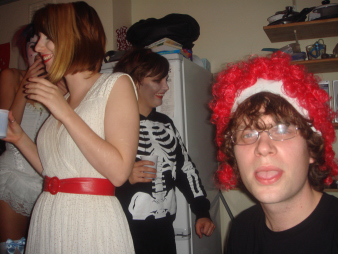
We were going to a party in London, New Cross - a friend of mine (her name is Ilona) is a arts student at Goldsmiths and it was her 21st birthday party. It was all planned, we would get there around 21.00, which was late but it was impossible to bend time any further. I finished uni at 16.15, Alan worked ‘til 17.10 and Eccles finished at 17.00 in Bristol. The plan was to rendez-vous @ 18.20 Bath Spa Station. Of course, sod being sod and the law being what it is, the buses were experiencing serious problems getting anywhere on time. Apparently, a gas pipe was leaking somewhere and roads were duly closed. It took me 2hrs to get home (it usually takes 20mins), I was not even dressed and the party was fancy dress (theme: gory vaudeville), I was not even sure if my skeleton tights which I had ordered from Ebay would arrive on time. It was all very stressful!
I got home, the tights had come by post (yes!) put them on, packed too much shit (had to bring sleeping bags, presents, change of clothes, beer, vodka, mixers...) got changed and got out of the door all in the space of 10mins! I had to walk to the station, because of the bus problem, but literally made it with TWO seconds to spare. Alan had cleverly gotten ready from work so he was on time and Eccles was waiving at us from the train. Stage one completed successfully....

Stage 2
The train journey itself was rather uneventful, just the usual spillages of alcohol whilst trying to mix drinks on a train, refusal to use public lavatories resulting in pee crisis (fortunately catastrophe was avoided), excruciating ticket prices, battling boredom, putting on make-up whilst on a moving train and going somewhere you’ve never been before.
Stage two was successfully completed when we arrived at Ilona’s house.

Stage 3
Final touches were put on my skeleton dolly costume and I entered the public domain of a beginning party. Much alcohol was consumed and much annoyance was experienced due to my inability to engage with people who refuse to have any opinions on anything (wtf?!). I’m recently encountering this type of person more frequently than I care and I don’t understand where it’s coming from. I especially see it in people in their early 20’s - I don’t know what they talk about amongst themselves. I ended up getting too drunk (mostly to numb the iritation and anger I was experiencing) and went to bed without making a complete arse of myself (and without throwing up)
Ilona in the background, Me, Anna and Eccles
Stage three successfully completed.

Stage 4
Eccles suggest we go camping with Chris (another ex-fellow flat mate from Colchester, now in Torquey) - today! Since I love camping and being impulsive, I’m very enthusiastic and optimistic about this turn of events. Besides I don’t enjoy London very much and prefer the great (healthy) outdoors. But before all that, we must restore our energies by eating an absolutely lovely breakfast (next to a not so lovely road). Breakfast and goodbye’s accomplished we jump on the train to journey back to Bath and Bristol.

Stage 5

2 hours later the next stage commences. Well to be honest it never really stopped, because throughout the journey back I was umming and arring as to whether to go camping or not. It was pretty far away (actually I wasn’t even sure exactly where it was we were going), I was pretty damn hungover, fed up with trains, tired, grumpy, and very skint. Every ten minutes I would announce to Alan that I was either going or not going. Eventually, I packed a bag, ate some soup and went to Bristol where I met Eccles. We got on another train, to Exeter St. Davids and Chris met us when he got on the train at the same station, and then subsequently made us travel illegally (but honestly, we owned up to the train conductor by telling him the truth and he was very understanding about it) to Newton Abbot, where we got off. We got our final supplies (such as batteries for the single flash light we managed to bring with us) and jumped into a taxi. It was 22.30 when we arrived. The taxi driver seemed to have a bit of a screw loose himself venturing into a long tale of aliens, sectioned friends, neuro-scientific trivia (which was wrong btw) and some more aliens. By the time we arrived to our destination Eccles and I had spent more than 8 hours traveling, not counting the previous day’s journey. We opened the taxi door to a heavy mist and complete darkness enveloped us a the taxi drove away and left us alone at the edge of Dartmoor.

Misty weather - it looks like rain, but it's not
Stage 6
Fortunately we were in safe hands with Chris as our guide. Having grown up in area he had many a years of exploring the moor. But it was a bit scary anyway, it being the equinox and as all good pagans know the time of year when the border between the living and the dead is at its thinnest. I felt a bit .. hmm ‘flaunting’ in my skeleton sweatshirt, as if I was mocking the dead there on the moor (as if on cue we started talking about the many ghost stories centered around the moor, we never mentioned it again though, probably because we’re all yellow chickens). Let it be said, disappointingly, that nothing out of the ordinary happened that night, although I was pleased that I’d never finished watching “The Blair Witch Project”. I have not seen mist so thick for a long time, only in the mountains, Chris directed us to a location and we managed to circumvent most of the cow pat when laying down the tent. The tent was one Eccles had found in his house, it was a large tent and we’d never put it up before. But even though we were tired, it was late, dark and misty we managed without no problems and quickly made our little nest. The rum, beer and wine was opened and the relaxation commenced, followed shortly by a deep sleep echoed with drumming of rain on the tent (there’s nothing quite like it).

Stage 7
We woke at 06.00. Bright and early with the sun rising and giving us the first view of Dartmoor. It was beautiful, and worth every painful moment, all regret dissipated and being there was all that was on my mind.

Chris made us some kind of sausage-wrapped-in-bread breakfast (a speciality of his), a pot of coffee was boiled (a tea towel was used a strainer) and soon after we were of on a walkabout in the beautiful surroundings.

I found a small waterfall with a prayer cave next to it
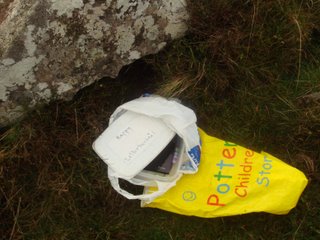
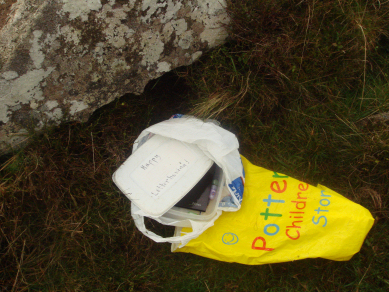
I also came across "letterboxing" which I've never heard off before, so it was pure luck to find it.

Eccles' protecting me from the fierce (wild) Dartmoor ponies. First I was curious and started approaching them, but then I got a bit anxious when all 3 of them started approaching me curiously... Very cute. And as you can tell from this photo, we had quite nice weather too.

Stage 8

As we returned to camp several hours later for our lunch, we saw that many people were now coming to take their Sunday stroll. Which seemed quite surreal to me. It was as if we were camping in a public park (which of course we were, it just didn’t look like any park I’d seen before). And we did get a few odd looks, but most were friendly.
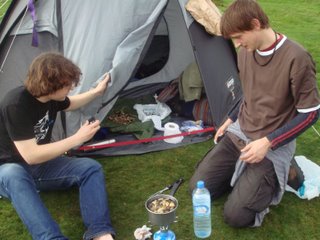

After our lunch we went for another walk and then came back to pack things up.
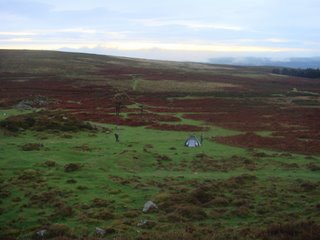


Our tent in the middle of (what we thought) was nowhere, but which was a both a popular tourist and local attraction.
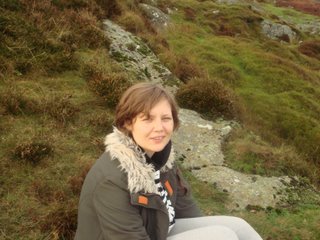
A groggy "hello" from me...
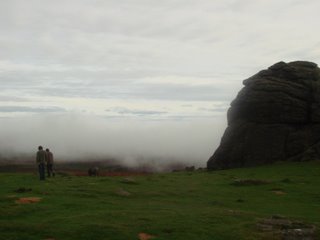

The mist comes rolling in. In the photo we have Eccles and Chris and the side of a Tor (can't remember which now...)

Stage 9
Fortunately a friend of Chris, Richard, was kind enough to come and give Eccles and me a ride back Newton Abbot. It was supposed to be so easy. On the train and be home in a few hours. Instead we were unaware of a train change, and continued on our merry way to Reading, where we had to change to go (back!) to Bristol. I then had to wait 40mins at Bristol to get a train (two stops!) to Bath. It was painful, and this time around there was no beautiful scenery to take away the painful journey memories. I’m sure they’ll dissipate with time... But until then I’m very hesitant about boarding a train!
I arrived home at 23.30. And that my friends is the end of the weekend tale.